Showing posts with label Ancient Mystery. Show all posts

Wednesday, July 6, 2022

The Lovers of Modena


In 2009 archeologists found a pair of skeletons in present-day Modena, Italy. The skeletons were buried with their hands interlocked. It's believed that two had died between the 4th and 6th century CE. It's believed the area they were found may have been a war cemetery.

It was an unusual grave as at the time people were not typically buried holding hands. It is not unheard of though as there were many other similar burials that went against the norm throughout history. Initially, because of the pose, it was believed that it was a man and a woman in the grave, but later testings on the enamel peptides by the University of Bologna proved it wrong. Both people in the grave were middle-aged men. It's unknown what the relationship was between the two. It's possible instead of lovers, they could have been, siblings, cousins, or close friends. All is known is that they would not have been buried this way without some sort of close relationship.

SOURCES:
Wikipedia

Friday, February 4, 2022

The Yingpan Man


The Yingpan Man is a mummy that was found in the Tarim Basin in China. He was 6'6" tall and had brown hair in a top bun. It's likely he was caucasian in his mid to late '30s. He had died in the 4th or 5th century, and his cause of death is either unknown or unstated. 

The Yingpan Man was found with a white mask on his face with a golden diadem across the upper forehead. He was wearing clothing that was a red, deep purple, and gold color. They had a pair of embroidered pants, decorative footwear, robe, and a belt woolen caftan. Everything was greatly detailed, and a miniature set was placed on his chest. Likely so he'd have something to change into in his next life. His clothing indicated that he had great wealth. 

With his clothing, when he died and the area he was buried it leads to the belief he was a wealthy tradesman on the Silk Road. His clothing is an example of what would have been woven in the Eastern Roman Empire and traded with the Tarim Basin and died far from his homeland. 

SOURCES:

Mummipedia Wiki

Archeology

History and Archeology Online

Sunday, January 23, 2022

Bog Bodies: Roum Man

In June of 1942, the severed head of a man was found in a bog in Himmerland, Germany. The head belonged to a young man about 20-years-old and the sheepskin wrapped around the head helped date him to the Iron Age. It was initially believed to be a woman's head, but the beard stubble on the dace now makes them believe they were a man. 

SOURCES:

Mummipedia Wiki

Wikipedia

Friday, July 17, 2020

Who was the Rosemarkie Man and Why was he murdered?

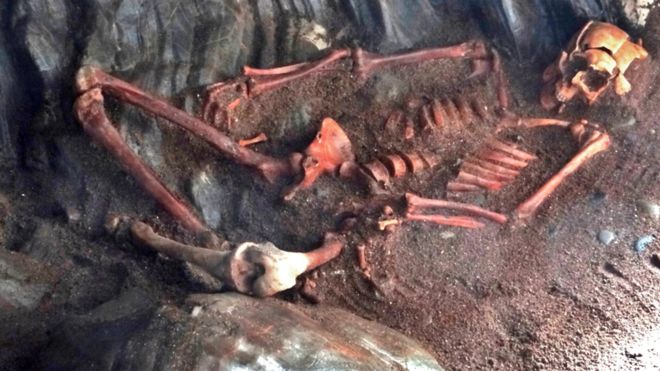
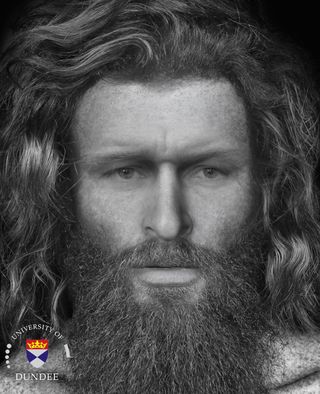
SkeletonPictish man

In 2016 members of the Rosemarkie Caves Project discovered the body of a medieval man in Black Isle, Ross-Shire in Scotland. He was found in the recess of the cave with his legs crossed and rocks on top of his limbs. He was possibly buried there because it may have been thought of as an "entrance to the underworld" as part of a ritual. animal bones near his remains showed there may have been a celebration for him. Even though it seemed as if he was carefully buried his death was brutal.

It's believed that he was Pictish. The Picts were a group of tribes in Scotland during the iron age and Medieval times. Romans gave them their name likely from the word "picti" which means painted ones. The Picts had distinctive tattoos and war paint.

The man had died between 430 to 630 and was around 30-years-old at the time. He was 5'6" and was well built much like a rugby player.  He likely had a high protein diet. The fact that he had a high protein diet and didn't have any injuries that warriors would have or wear and tear from being a laborer it's believed he was Royal or a Chieftain. 

His end was not pleasant. He had been attacked about the head 5 head injuries With a weapon the first 3 impacts broke his teeth and fractured his left jaw and the back of his head. The 4th, which likely ended his life, the weapon used was driven through his skull from one side out the other as he was laying on the ground. 

It's unknown who this man was and why he was killed and this will remain a mystery. 

SOURCES:
BBC July 24, 2019
BBC Feb. 17, 2017


Tuesday, June 23, 2020

Girl Murdered by Ancient Soldiers

Image Credited to BBC
Archeologist excavating near a former Roman settlement in the county of Kent, England, lying in a shallow grave was the skeletal remains of a young woman between 16 and 20 years old. Her shallow grave was amid ancient military gear believed to be left behind from the 1st Century Claudian invasion. Inside her grave with her were pottery pieces dated around 50 A.D. about four years after the Claudian Invasion.

It was believed that the items found in the trench were abandoned after the Romans were done taking over the area. They dug pits and dumped broken or unneeded things for their travel. They had done the same with the girl. Possibly her use to them was done when they left. They were done with her.  She was in a kneeling position and was stabbed in the back of her head.

They didn't even give her a nice burial as they dug a shallow grave and dumped her in and covered her with dirt. She was lying face down in her grave her body laid twisted. One foot was out of the grave and one of her arms underneath her.

There is little known about the girl. She was young and healthy and was likely a native to the area, unlike the invading Romans. Another indication she was native was that she was buried North/South instead of East/West/.

Her story has unfortunately been lost to time.

SOURCES:
BBC
History
UPI


Thursday, May 28, 2020

Murder of Ginger (Gebelein Man)


There were 6 bodies found in the Gebelein, Egypt dating around 3400 BC. They were excavated in the late 1800s by Wallis Budge. At this time that mummification Egypt is known for wasn't developed. The mummies were naturally mummified by being placed in a shallow grave in direct contact with hot and dry sand that would absorb the body's liquids. They were in a curled, fetal position because that was common practice at the time. One of the more notable mummies in this excavation was the Gebelein Man or Ginger as he was a murder victim.

Ginger was around 18 to 21-years-old when he died. He had notable red hair that was preserved with his body and this gave him his nickname. After some infrared scans on the body, it was found that he had a tattoo of a figure that looked like a smudge without the scan. Which may have been the oldest preserved tattoo of figures.

Through analysis, it was determined that he had had been murdered. He had injuries that coincided with a deliberate assault. His shoulder blade was damaged and the rib underneath shattered likely from a stab wound. He was likely surprised by the attack as he had no defensive wounds. The weapon used was a copper or flint blade at least 5 inches long.

Why he was murdered and who he was is now lost to time. His body is currently at the British Museum in London, England.

SOURCES:
Mummipedia Wiki
News Week
British Museum
Egypt Orgins
Wikipedia

Sunday, September 29, 2019

Who Are The Occupants of the "Tomb of the Athlete"

In the Casse Rosse area west of the center of Rome a miraculous discovery happened. Most Ancient burials are typically destroyed by time, people, and mother nature.  During construction in the area, by an earthmover working to extend an aqueduct about 6 ft underground. What was found was a tomb with four people inside was revealed. The tomb itself was untouched and what was buried there stayed there.

The four people were a man in his 30's, a man in his 50's, a man between 35 and 45 and a woman of undetermined age. The man in his 30's and the man in his 50's was laid out on counters, and the woman and They had died sometime in the 4th century.

It also unearthed jugs, dishes, a bronze coin (dating between 335 and 312), two strigils, and dishes of chicken, rabbit and other animals like lamb or goat. Likely left in the tomb as offerings to feed them in the afterlife.

The strigils were what helped termed the tomb "Tomb of the Athlete". Strigils were used during bathing to wipe off oil and to wipe the sweat off of bodies of athletes. The strigils were used in ancient Greece and Rome as a symbol for athletes. But the men in the tomb were over the athletic age and were probably not athletes at the time of their death.


SOURCES:
Ancient Origins 
Realm Of History
Smithsonian Magazine  
The Local
The New York Times

Sunday, August 11, 2019

The Yde Girl Mummy

Images of her and the 1992 reconstruction of her face. 

On May 12, 1897, a man working in the Stifveen peat bog near Yde, Netherlands a well-preserved mummy of a teenaged girl. They referred to the girl as Het Meisje van Yde in Dutch.Which it meant the girl from Yde.

Yde Girls body wasn't turned over to authorities till two weeks after she was found. Due to the conditions that a bog has, it allows bodies inside of it to mummify. Her body went through some deterioration and decomposing due to mishandling. People also came to see the body and took hair and teeth from the body.

The mummy had Carbon-14 dating done on her. It was found she had died between 54 BC and 128 AD. She had died around 16 years old.  It was found she had scoliosis of the spine and stood at 137 cm and was short for her age. Her hair was nicely preserved as it was long and reddish-blonde hair. It's possible one side of her head was shaved, but sometimes this shaved feature is seen in bog bodies and it's possible that that side of her head was in oxygen a bit longer.  She was wearing a woolen cape and around her neck was a braided woolen band. The braided band was wrapped around her neck three times.

She had a stab wound to her collar bone, but it is unknown if this was what killed her. It's believed the stabbing happened when she unconscious as there were no defensive wounds.


Her name and story are lost to history. It's not sure why she had died or why her body was left in a Peat Bog. Some speculate that she was murdered or sacrificed. Others think that maybe the woolen band around her neck is evidence that she killed herself. It's not sure what really happened to the girl.

SOURCES:
Mummipedia
Awesome Stories
Atlas Obscura
Wikipedia


Wednesday, January 16, 2019

What Was The Venus De Milo Doing With Her Hands?


Venus De Milo also known as Aphrodite of Milos is a Hellenistic statue located at the Louvre Museum in Paris, France. She was discovered on the island Melos in 1820 by a French Navy Officer, Voutier, and a farmer. It's believed to have been created in the 2nd century B.C. possibly around 150 B.C. by Alexandros of Antioch. She's nearly nude with stands at 6 ft and 8 inches tall, and like many Greek statues, she's missing her arms. It's believed that she is supposed to represent a Goddess, possibly of Aphrodite or Artemis or Danaid, or Amphitrite.

The thing that is shrouded in mystery with this one is what she's doing with her arms. It's believed that she may be doing something with her hands, but since they were broken before or during her discovery it's unknown.

Some believe that she's holding something or leaning on something. It's possible that there may have been another human in it possibly resting her elbow on Ares' shoulder. She could have been holding an apple, bow, amphora, mirror, crown, shield. It's unknown and will likely never be known.


SOURCES:
https://mymodernmet.com/venus-de-milo-statue/

Saturday, November 17, 2018

Doppelgangers or Spirit Doubles

Natalie Portman and Keira Knightly

Doppelgangers are people who seemingly look exactly alike, but have no biological relation. The term Doppelganger was first used by German author Johann Paul Ritcher under the pen name Jean-Paul in 1796. It means double goer and was to describe spirit doubles in German Folklore.

According to old German folk tales All living creatures have a spirit double that lives an identical but invisible life. These spirits were essentially the "evil spirit twin" or the Mr. Hyde of the relationship to a person. These double spirits are distinctive from ghosts, as ghosts only show after death.

Seeing a doppelganger is seen as an omen. They show no shadows and is a replica or double of a living person. Sometimes they are considered to be a warning of an impending death. If relatives or friends see a doppelganger it would mean they'd become ill or in danger. If a person saw their own doppelganger it meant death.

The doppelganger may give their person advice. The advice, unfortunately, will be filled with malace or implant evil thoughts into their mind. All in all, it was known to not trust a doppelganger if you were to meet one.

Spirit doubles are in many civilizations throughout history.

The earliest references to spirit doubles were found in Zoroastrianism on the Zurvanite branch. They have an abstract duality of Zoroastrianism which is pictured as twins born of good and evil. The twin sons of Ahura Mazdā. Angra Mainyu was representative of evil and Spenta Mainyu is representative of the holy spirit.

Scientists say there is a completely logical reason for people who look the same to not be biologically connected. Humans are meant to look different for the importance of individuality in our species. Our features vary more than other animals do, but our genetics do not.

So while many people look different odds are that people will look similar even though they aren't biologically related. You'll find that they look almost identical, but if you take a closer look they aren't identical. You'll find that even if you find your doppelganger you'll see something they don't have that you have or vice versa. You can see similar features in modern religions like for example God and the Devil in Christianity.

In Ancient Egypt, Ka is said to be a spirit double that has the exact memories as the person. The exact definition of Ka is controversial though and may not mean as a spirit double, but as a protecting divine spirit of a person.

SOURCES:
https://www.merriam-webster.com/dictionary/doppelg%C3%A4nger
https://globalnews.ca/news/2300048/your-doppelganger-exists-according-to-science-heres-why/
https://www.ancient-origins.net/myths-legends/doppelgangers-and-mythology-spirit-doubles-001825
https://mythology.net/others/concepts/doppelganger/

Wednesday, November 7, 2018

The Great Wall of California: Berkeley Mystery Walls


There is a wall that stretched 50 miles long in California. It stretches from Berkley to San Jose. It is made of rocks and boulders stacked upon each other, in some places and some of the boulders weigh a ton. Some places are five feet tall, but it at most isn't very tall. It had breaks in it that go on for meters to half a mile in some places. It even leads up or from a mysterious stone circle and the wall spirals for 200 feet and encircles a large boulder.

It's not known why the wall was originally built or who had built it or if it had served any real purpose at all. It wasn't tall enough for defensive purposes and sometimes the layout of the wall is inaccessible and unusual places. It could be possible that it has some sort of religious affiliation originally, but that is all lost now. 

Some theorize that maybe it wasn't Native American's who formed it. Some think that it could have been early missionaries who created it or even Mongolians who settled in the area may have created. In reality, we may never find out who created the wall and for what purposes, but it's a beautiful ancient site to see. 

SOURCES:
https://www.atlasobscura.com/places/berkeley-mystery-walls
https://www.mercurynews.com/2015/11/23/bay-area-facts-berkeley-mystery-walls-origins-not-so-off-the-wall/
http://www.ancientpages.com/2015/10/28/mystery-of-great-wall-of-california-an-ancient-unsolved-enigma/

Monday, August 14, 2017

The Devils Bible


Photograph courtesy to The National Library of Sweden.

The Codex Gigas (Latin for Giant book) or the Devil's Bible is single handedly the biggest book or manuscript from the Middle Ages. It is massive with 310 parchment leaves or pages made from a from 160 different animals (most likely donkeys or calfskin). There are unfortunately a few pages missing from it. This monster of a book weighs a whopping 165 lbs and it takes two adults to lift it. People call it the Devil's Bible not only because of the picture of the Devil in it, but because of the legend that comes with it.

The legend goes that a 13th century Benedict monk broke his vows. For the punishment of  that he was sentenced to be walled up alive. In an attempt to save his own life he promises to write a book in a single night of all human knowledge. Out of mercy they accepted his plea, probably not believing he'd do it. When the monk realized that he could not finish the book he turned to the Devil for help. In return the Devil asked for his soul and the monk gladly gave it to him. In thanks for that the monk dedicated a picture to the Devil.

In reality it is believed they do believe that it was worked on by a single monk, but it was over decades and not a single night. there have been test done that show the calligraphy alone would had taken 5 years of none stop writing. It isn't known who the monk was and no other work done by him had ever been found.

It is believed to be the only bible of that era to depict the Devil. Even though there were many depictions of the Devil in painting the one in this book has a whole page dedicated to him by himself which was rare. On the other side was a picture of  the heavenly city. These are the only two images in the book in which a whole page was dedicated to.

                            Photograph's courtesy to The National Library of Sweden

In the book there many works inside of it. Many of the works include the Bible, some medical information of the time, a calendar, science and alchemy and even more. Even though the legend says that the Devil helped the monk there isn't actually any indications of the Devil being seen in a good light. More than likely the images were placed in the book next to each other to show representations of Good and Evil.

On the pages that followed the Devil image there are instructions and rituals on how to exercise demons. Illnesses during the middle ages were thought to have been caused by the possessions of demons. It wasn't just people, but objects that could be exercised.

It is unsure what the origin of the The Codex Gigas. It is believed to be created in Bohemia which is now modern day Czech Republic. A note in the manuscript stated that it was pawned off by the Podlažice Monks to the monastery at Sedlec in 1295. It was then passed to the monastery of Břevnov near Prague. It isn't known the exact place it was created and it isn't known if it was created at Podlažice, but there is a possibility it was.

In 1594 Rudolf II, who was King of Bohemia 1575-1611, moved the Codex Gigas to his castle in Prague. It remained there up until the 30 Year War and was taken by Sweden. It was then placed into a collection at a Stockholm royal library by  Queen Christina of Sweden. It was the put in the National Library of Sweden where it now resides.

So do you believe the legend of the Devil's Bible or that it was the work of a determined monk?

SOURCES:
https://voices.nationalgeographic.org/2008/12/17/devil_bible/
https://aleteia.org/2017/04/12/its-not-the-devils-bible-its-just-the-codex-gigas/
http://www.kb.se/codex-gigas/eng/short/history/




Chu "Joe" Wong Kung

On September 26, 1946, 50-year-old Chu "Joe"  Kung was visiting Calgary, Alberta, Canada. He was at the time staying at the Alexan...